
Designing a Reliable Real-Time Inbox: Lessons from Production Systems
How we balance speed, consistency, and complexity in building a real-time messaging system that actually survives production.
1. Introduction and Architecture Overview
Modern inbox systems look deceptively simple on the surface, typically presenting a list of conversations, a thread view, and real-time updates. Under the hood, however, they represent one of the most complex components of any Software-as-a-Service (SaaS) product. Once real-time communication is introduced, the engineering challenge shifts from a user interface (UI) problem to a complex distributed consistency problem. Issues such as duplicate events, race conditions, connection drops, partial payloads, and stale state frequently emerge in production environments. This article examines the architectural decisions behind developing a real-time inbox system, analyzing the trade-offs required to maximize both speed and reliability.
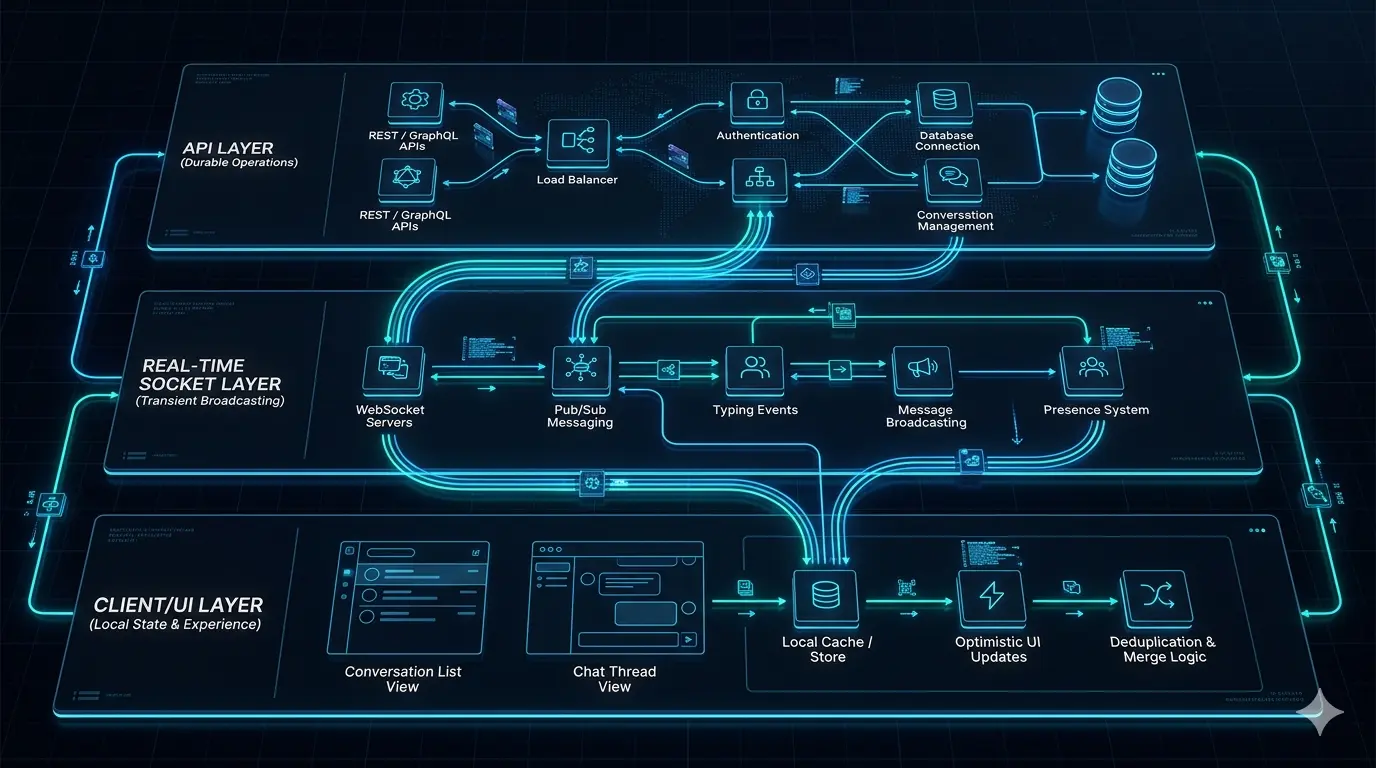
At the core of a resilient system is a strict separation of responsibilities across three distinct layers:
The API Layer: Responsible for handling durable operations, including sending messages, loading conversations, and updating persistent state.
The Real-Time Layer: Responsible for broadcasting ephemeral updates, such as new messages, typing events, and status changes.
The Client Layer: Focuses on maintaining a local state optimized for responsiveness, fluid navigation, and user experience.
Within this architecture, real-time channels are treated strictly as a synchronization mechanism rather than a source of truth. The server remains the ultimate authority, ensuring that data integrity is maintained across all sessions. To avoid tight coupling and ensure updates remain highly targeted rather than global, the inbox domain is split into two primary components:
1. A Paginated Conversation List: Used exclusively for navigation, high-level overviews, and broad state changes.
2. A Full Conversation Thread: Dedicated to detailed, message-level interactions within an active chat.
2. Real-Time Synchronization and Data Consistency
To maintain a performant interface, real-time updates are applied incrementally to the client state instead of triggering full, expensive database refetches. Each incoming event updates only its relevant state fragment, such as a specific message, a single conversation row, or an unread counter.
However, real-time data streaming is inherently unreliable by default. Production environments frequently encounter several persistent synchronization challenges:
Duplicate event delivery
Out-of-order event delivery
Partial data payloads
Events arriving before the client UI has finished initializing
To mitigate these challenges, incoming updates are systematically merged into the existing local state rather than replacing it entirely. When incoming payloads are incomplete, existing data fields are preserved to prevent data loss. Furthermore, rigorous deduplication mechanisms are implemented at the event transport boundary. Without deduplication, repeated socket emissions can cause duplicated message rendering or corrupted UI counters, rapidly degrading user trust.
Caching and State Management
Conversation data is cached locally upon the initial load to eliminate redundant network requests and accelerate navigation. This local cache acts as a vital bridge between standard API HTTP responses and active real-time socket updates.
Because real-time payloads are often partial, careless state mutations can accidentally overwrite valid cached fields. Consequently, updates must be applied conservatively, ensuring that missing payload fields never erase existing, valid state. This protective merging process prevents silent data corruption, which stands as one of the most difficult anomalies to debug in production environments.
3. Optimistic UI and Perceived Speed
Creating a responsive, world-class user experience requires applying UI actions optimistically. Messages appear instantly in the thread upon being sent, and counters decrement or increment immediately as user actions occur. However, optimistic updates cannot function in isolation; they must always be paired with a robust reconciliation mechanism. If an API operation ultimately fails, the UI must never silently fail or remain stuck in an invalid state. Instead, it must accurately reflect the failure, preserve the user's input, and provide an explicit option to retry the action.
The guiding philosophy is straightforward: the system should feel instant, but it must never remain permanently incorrect.
4. Reliability, Scalability, and Production Edge Cases
A production-grade real-time inbox must be engineered to operate predictably under highly imperfect conditions. Networks drop, browser tabs enter sleep modes, events arrive late, and redundant delivery channels may emit identical updates simultaneously. The system navigates these conditions via a layered recovery architecture:
WebSockets: Utilized for rapid, low-latency real-time updates.
REST APIs: Utilized as the authoritative fallback to establish definitive state.
Background Reconciliation: Automated polling or state diffing routines that run silently to patch discrepancies and enforce eventual consistency.
This layered strategy ensures that when infrastructure components fail, the application degrades gracefully rather than failing unpredictably.
Production Edge Cases
The architecture of a real-time inbox is ultimately shaped more by messy, real-world edge cases than by standard feature requirements. The system must natively handle several normal production anomalies:
Multi-Channel Duplication: Handling identical events emitted concurrently across multiple connections.
Race Conditions during Transitions: Managing messages that arrive precisely while the user is navigating between different application routes.
Mid-Session Transfers: Handling live chat transfers between agents or departments while a conversation thread remains actively open.
Reconnection Replays: Properly filtering out stale, historic events replayed by a socket connection during a reconnection phase.
Nested Field Partial Updates: Merging partial updates that omit deeply nested data structures without wiping out existing sub-properties.
Resource Throttling: Maintaining sync integrity when modern web browsers heavily throttle WebSocket traffic and JavaScript execution in background tabs.
Performance and Scalability Optimization
High performance across these edge cases is achieved primarily by minimizing unnecessary computational and network overhead. Five core optimizations keep the system scalable:
Optimization Strategy
Implementation Details
Lazy Loading
Conversations and heavy metadata are only fetched when explicitly requested by user interaction.
Data Pagination
Large conversation lists are broken into smaller, paginated chunks to reduce payload sizes and initial render times.
Scoped Updates
State mutations are precisely scoped to isolated fields rather than triggering global context rerenders.
Debounced Calculations
Expensive UI calculations and state re-indexing operations are debounced to prevent CPU spikes during high-frequency event bursts.
Local Ordering Logic
Message and thread ordering are handled dynamically on the client side, eliminating the need to request a fully re-sorted list from the server.
5. Lessons Learned and Future Improvements
Real-time architectures are fundamentally not about achieving instant updates; rather, they are exercises in engineering data convergence. Because perfect ordering and absolute consistency cannot be guaranteed in a distributed system, the primary engineering objective must be ensuring that the system always converges back to a correct state.
Key Architectural Takeaways
Boundary Deduplication: Deduplication mechanisms must exist at the very edge of the transport boundary to eliminate redundant processing.
Explicit Failure Handling: Optimistic UI designs are incomplete and risky without dedicated, explicit failure-handling and state-reversal workflows.
Expected Partial Payloads: Partial payloads must be treated as standard, expected behavior rather than exceptions to the rule.
Sockets are Not Sources of Truth: Socket connections should never be trusted as the authoritative ledger of state; they are merely transient transport lines.
Future System Improvements
1. Offline Message Queuing: Implementing a robust client-side storage queue to hold sent messages during network loss and auto-retry synchronization upon reconnection.
2. Stronger Event Versioning: Utilizing sequential sequencing tokens or vector clocks to ensure safer, deterministic client-server synchronization.
3. Granular Cache Invalidation: Transitioning away from broad cache sweeps in favor of precise, field-level invalidation paths.
4. Enhanced System Observability: Developing deeper telemetry pipelines to track real-time event latency patterns and capture duplication anomalies in the wild.
Final Note
Building a reliable real-time inbox is ultimately an ongoing exercise in managing uncertainty. The core engineering challenge is not removing inconsistencies entirely, but making them invisible to the end user through defensive design, layered recovery protocols, and predictable system convergence.