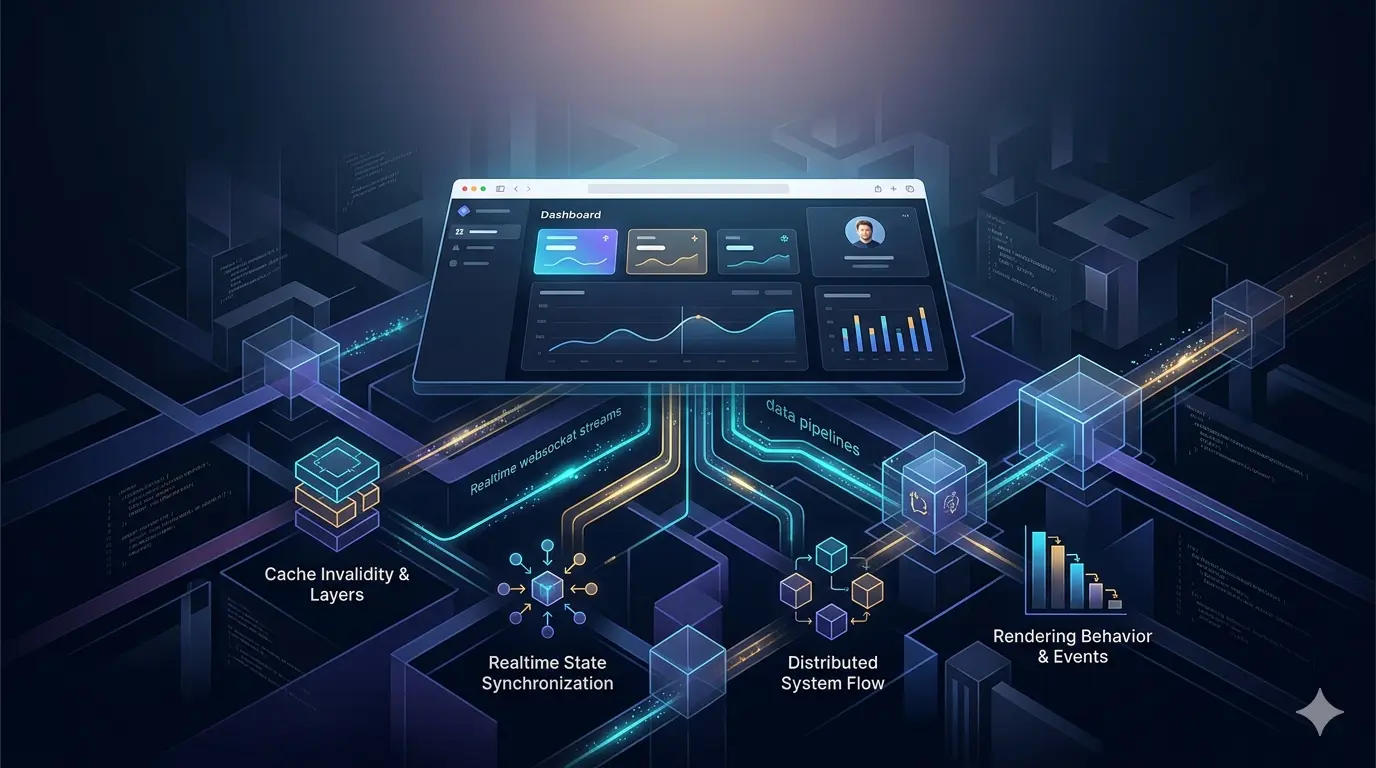

Frontend Engineering Beyond Components
Frontend Engineering Beyond Components
A lot of frontend discussions still revolve around components.
Reusable components.
Design systems.
Composition patterns.
UI libraries.
Clean abstractions.
Those things matter.
But after working on larger production systems, I’ve realized that components are usually the easy part.
The hard part starts when the application becomes complex enough that correctness, synchronization, and predictability matter more than UI composition.
That’s the point where frontend engineering begins to move beyond components.
Components Are Rarely the Real Problem
Most frontend applications do not become difficult because of buttons, modals, or cards.
They become difficult because of:
- shared state
- realtime updates
- cache invalidation
- synchronization
- rendering behavior
- permissions
- async coordination
- side effects
- data ownership
Building a modal is easy.
Keeping the entire application correct after that modal updates shared state across multiple screens is much harder.
That difference becomes more obvious as products grow.
One thing that changed my perspective on frontend engineering was working on larger production systems where UI complexity stopped being the main challenge.
In smaller applications, frontend development often feels straightforward:
render the UI, fetch data, handle interactions, and move between pages.
But as products grow, the frontend slowly becomes responsible for much more than rendering components.
Now the application has to coordinate:
- realtime updates
- shared state
- websocket events
- background synchronization
- optimistic updates
- caching
- permission-based rendering
- multiple layouts
- rendering performance
- failure recovery
At that point, frontend engineering starts feeling much closer to systems engineering.
And that changes how architectural decisions should be made.
Frontend Complexity Is Mostly System Complexity
In smaller applications, frontend work feels mostly visual.
You render data.
Handle interactions.
Move between pages.
The architecture stays relatively manageable because the number of moving parts is small.
But in large applications, the frontend slowly starts behaving more like a system than a UI layer.
Now the application has:
- realtime events
- websocket updates
- optimistic state
- background synchronization
- shared caches
- derived state
- permission-based rendering
- multiple layouts
- cross-page dependencies
At that point, the challenge is no longer:
“How do we render this component?”
The challenge becomes:
“How do we keep the system predictable as state changes from multiple places simultaneously?”
That is a very different engineering problem.
Modern frontend systems no longer behave like static interfaces.
They behave like continuously synchronized environments where multiple parts of the application react to changes happening across routes, layouts, services, tabs, and external systems.
This is one reason why frontend complexity has increased so much over the last few years.
The UI itself is often not the difficult part anymore.
Coordination is.
State Ownership Matters More Than Component Structure
One of the biggest frontend engineering mistakes is focusing too much on component organization while ignoring state ownership.
A clean component tree does not automatically create a maintainable system.
Large frontend applications become difficult when ownership becomes unclear.
Questions like:
- Who owns this data?
- Who invalidates this cache?
- Who synchronizes realtime updates?
- Which part of the system is the source of truth?
- Who handles retries and failures?
- What happens after reconnect?
become more important than component composition.
In production systems, unclear ownership creates:
- duplicate updates
- stale cache
- inconsistent UI
- rendering cascades
- synchronization bugs
- debugging nightmares
The hardest frontend problems are usually coordination problems.
Realtime Systems Expose Weak Architectures Quickly
Realtime applications make frontend complexity much more visible.
A single websocket event can suddenly affect:
- unread counts
- sorting logic
- notifications
- chat lists
- layout badges
- active conversations
- background tabs
- cached state
Without clear boundaries, one small update spreads through the entire application.
This is where many frontend systems start feeling fragile.
The issue is rarely React or Vue themselves.
The issue is uncontrolled synchronization and implicit update propagation.
Frontend Performance Is Also a System Problem
A lot of frontend performance discussions focus on rendering tricks:
- memoization
- lazy loading
- virtualization
- computed caching
Those optimizations matter.
But many rendering problems actually start earlier in the architecture.
Usually the problem is not:
“this component rendered.”
The problem is:
“why did this update spread so broadly?”
Large frontend systems become slow when:
- state becomes overly global
- subscriptions become too broad
- rendering boundaries disappear
- ownership becomes unclear
Performance problems are often symptoms of architectural problems.
Frontend Engineering Is About Tradeoffs
One thing production systems teach quickly is that frontend engineering is mostly tradeoff management.
Examples:
- local state vs global state
- optimistic updates vs server truth
- abstraction vs explicitness
- reusability vs coupling
- SSR vs client rendering
- synchronization accuracy vs performance cost
There is rarely a perfect solution.
Most decisions optimize for:
- predictability
- maintainability
- operational simplicity
- debugging
- scalability
—not theoretical elegance.
Modern Frontends Behave More Like Distributed Systems
Modern frontend applications now coordinate:
- server state
- local state
- websocket events
- background sync
- optimistic UI
- multiple tabs
- async rendering
- cache layers
That starts looking surprisingly similar to distributed systems.
The frontend is no longer just rendering data from APIs.
It is coordinating multiple sources of truth while trying to keep the user experience consistent and responsive.
Components Are Still Important
None of this means components do not matter.
Good UI composition still matters.
Design systems still matter.
Reusable patterns still matter.
But components are only the visible layer of the application.
The deeper engineering complexity lives underneath:
- synchronization
- ownership
- rendering behavior
- state consistency
- cache management
- failure handling
- architectural boundaries
That is where large frontend systems either remain maintainable or slowly collapse under complexity.
Final Thought
Frontend engineering stops being mostly about components the moment the application becomes large enough that predictability matters more than composition.
At scale, the hard part is rarely rendering the UI.
The hard part is keeping the system correct while state changes continuously from multiple places at once.
That is where frontend engineering truly begins.